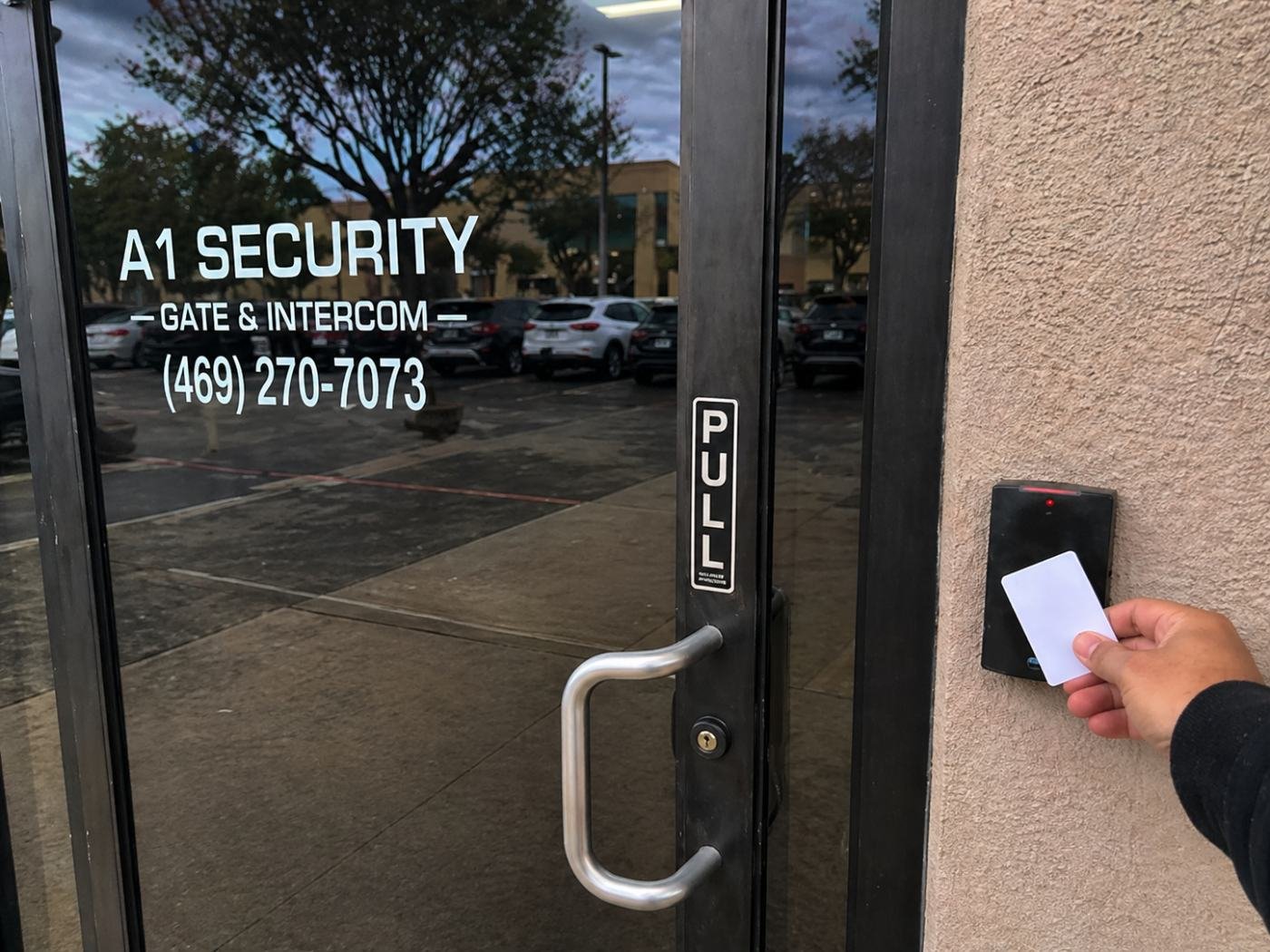
Commercial access control is a different project than a single residential door lock: it’s a system that has to scale across employees or tenants, coordinate with door hardware and fire code, and stay manageable as people join and leave the organization. Getting the design right up front avoids the most common and expensive mistake — retrofitting a system that was sized for a much smaller building.
This guide focuses on planning a commercial access control project: credential types, hardware coordination, cloud management, and how the right design differs across offices, warehouses, retail and multifamily properties. For general residential and small-business installation pricing, see our access control cost guide.
On this page: Credential and management options · Door hardware coordination · Fire and life-safety considerations · Scalability and cloud management · Offices, warehouses, retail, multifamily · Commercial cost factors · Code & compliance · DFW & Allen specifics · Common mistakes · Planning process · Questions to ask · Glossary · FAQ
Credential and Management Options
Quick answer: Commercial systems typically use card/fob credentials, mobile credentials, or a mix, tied to a management platform that assigns and revokes access per employee or tenant — not shared codes like a residential keypad.
The core difference from residential access control is credential management at scale: adding a new employee, revoking a terminated one, or setting different access schedules for different roles all need to happen without touching the door hardware itself. See our keypad vs. card reader vs. mobile access guide for a deeper comparison of credential types.
Door Hardware Coordination
Quick answer: Access control has to be designed alongside the door hardware — electric strikes, magnetic locks, and exit devices — not bolted on afterward. The wrong pairing can create a code violation or a door that doesn’t latch reliably.
An electric strike, magnetic lock, or panic exit device all interact differently with an access control system, and the choice affects both security and code compliance. See our electric strike vs. magnetic lock guide and our commercial door locks page for how these integrate.
Fire and Life-Safety Considerations
Quick answer: Any electrified door on an egress path must allow free exit at all times, per fire code — access control secures entry, never exit. This is coordinated with panic hardware and fire alarm interconnection where required.
A common design mistake is treating access control and fire/life-safety as separate systems when they need to be coordinated from the start. Doors on a required egress path need hardware that always allows exit, regardless of the access control system’s state, and in many jurisdictions must release on fire alarm activation. This is a code requirement, not a design preference.
Scalability and Cloud Management
Quick answer: Cloud-managed access control lets a business add doors, locations or users without a proportional increase in on-site hardware or IT overhead — a meaningful advantage for growing businesses or multi-location operators.
A cloud-managed system centralizes credential and permission management across every door and every location from one dashboard, which matters most for businesses that expect to grow, add locations, or need remote management across a portfolio of properties. See our keypad vs. card reader vs. mobile access guide for how credential types factor into a cloud-managed system.
Offices, Warehouses, Retail and Multifamily: What Changes
Offices typically need role-based access (different zones for different departments), visitor management, and integration with a reception or lobby entry point.
Warehouses often need to control both pedestrian doors and vehicle gates — see our access control page for how this pairs with a gate installation — plus time-based schedules for shift workers and delivery access.
Retail properties typically need simpler single or dual-door access control paired with security cameras covering entries and point-of-sale areas.
Multifamily and HOA properties need tenant-level credential management, often paired with an intercom system for visitor access — see our apartment and multifamily intercom guide.
What Drives Commercial Installation Cost
- Number of doors — each controlled door needs a reader, door position sensor, and often an electrified lock.
- Existing door hardware — retrofitting older hardware costs more than specifying compatible hardware from the start.
- Network and cabling infrastructure — buildings without existing structured cabling need more electrical and network work.
- Cloud platform and licensing — ongoing software cost scales with door and user count.
- Integration needs — tying access control into cameras, alarms, or a gate system adds design and labor time.
Because commercial project scope varies so widely by door count and building condition, we provide project-specific quotes after a site assessment rather than a general price range here.
Code and Compliance
Commercial access control installations should account for ADA accessibility at controlled entries, local fire code requirements for egress hardware, and any building-specific life-safety requirements. Installers in Texas are licensed through the TDLR — ours is License #B31188501.
Commercial Access Control Across Dallas, Fort Worth and Allen
We design and install commercial access control for offices, warehouses, retail and multifamily properties across Dallas, Plano, Frisco, Allen and McKinney, as well as commercial corridors throughout DFW. See our commercial access control service page for more.
Common Planning Mistakes
- Designing access control without involving a locksmith or door hardware specialist, leading to code conflicts.
- Choosing an on-premise system for a business that plans to add locations, creating unnecessary IT overhead later.
- Not planning for visitor or contractor access, forcing awkward workarounds after installation.
- Underestimating network and cabling needs in older commercial buildings.
Planning a Commercial Access Control Project
- Site assessment — walking every controlled door, existing hardware, and network infrastructure.
- System design — credential type, platform (cloud vs. on-premise), and door hardware pairing.
- Fire and life-safety review — confirming egress hardware and any fire alarm interconnection requirements.
- Written proposal — itemized by door, hardware, and platform licensing.
- Installation and programming — hardware install, network configuration, and credential setup.
- Training and handoff — showing your team how to manage credentials going forward.
Questions to Ask Before Hiring a Commercial Integrator
- Are you licensed and insured in Texas? (We are — TDLR License #B31188501.)
- Do you coordinate with our door hardware and fire/life-safety requirements? Not just install readers in isolation.
- Is the platform cloud-based, and can it scale with us? Ask about adding doors, locations or users later.
- Can this integrate with our cameras, alarms, or gate system?
- Will you provide a written, itemized proposal by door and system component?
Glossary: Commercial Access Control Terms
| Egress Hardware | Door hardware that always allows exit regardless of the access control system’s state. |
| Credential | The card, fob, mobile pass or code used to request access at a reader. |
| Cloud-Managed System | An access control platform managed remotely rather than from an on-site server. |
| Door Position Sensor | A sensor that reports whether a controlled door is open or closed. |
Planning Your Commercial Access Control Project
Because commercial projects vary widely by door count, hardware and building condition, we start with a site assessment. Call 682-516-9940 or request a free estimate below.
Frequently Asked Questions
What's the difference between residential and commercial access control?
Commercial systems need credential management at scale across many employees or tenants, coordination with door hardware and fire code, and often multi-door or multi-location scalability that residential systems don't require.
Can access control integrate with our fire alarm system?
Yes, and on egress doors it often must, so that doors release automatically during a fire alarm event per code requirements.
Is cloud-based access control better for a growing business?
Generally yes. A cloud-managed system lets you add doors, locations or users without a proportional increase in on-site hardware or IT overhead.
Do warehouses need different access control than offices?
Yes, warehouses often need to control both pedestrian doors and vehicle gates, plus time-based schedules for shift workers and deliveries.
What credential types work best for a multi-tenant building?
Card, fob or mobile credentials managed through a cloud platform generally work best, since they can be assigned and revoked per tenant without touching hardware.
Can access control secure both entry and exit?
It's designed to secure entry; on required egress paths, exit must always be freely available regardless of the access control system's state.
Do you handle the door hardware as well as the access control system?
Yes, we coordinate electric strikes, magnetic locks, and exit devices as part of a commercial access control project.
How long does a commercial access control installation take?
It varies significantly by door count and building condition; we provide a project timeline as part of the proposal after a site assessment.
Do you provide ongoing support after installation?
Yes, including training on credential management and ongoing service for the system.
Do you serve Allen and the greater DFW area for commercial access control?
Yes, we design and install commercial access control across Dallas, Fort Worth, Allen, Plano, Frisco, McKinney and the surrounding North Texas area.