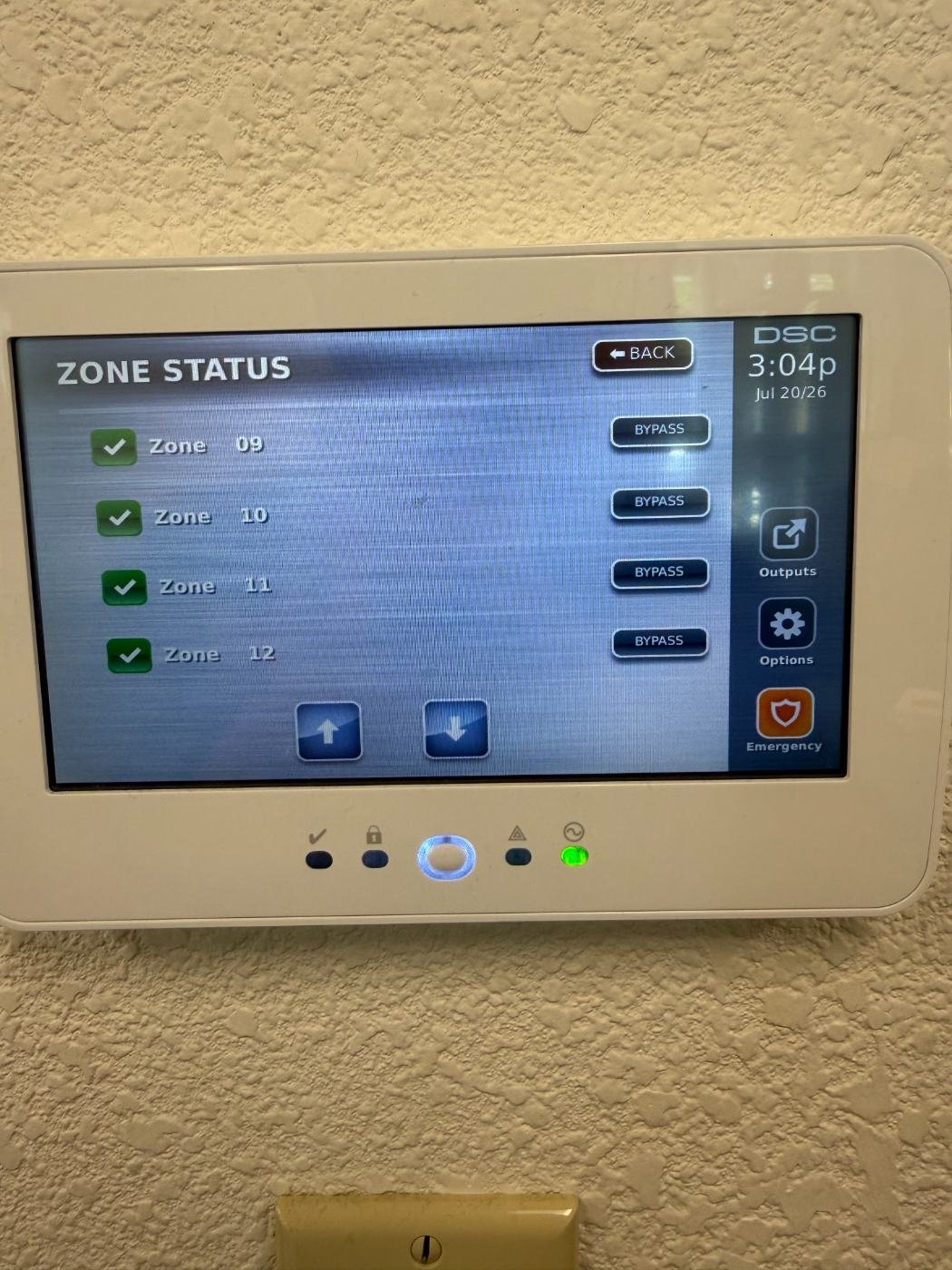
An alarm system is only as good as its sensor placement — a panel with a dozen zones isn’t protecting a property if the actual entry points and paths an intruder would use aren’t covered. Placement matters more than raw sensor count.
On this page: Door and window contacts · Motion sensors · How many you need · Priority order · Pet-friendly motion sensing · Code & compliance · DFW & Allen specifics · Common mistakes · Glossary · FAQ
Door and Window Contacts
Quick answer: Every ground-floor entry door and easily-accessible window should have a contact sensor. These are the first line of detection, triggering the instant an opening is breached.
Door and window contacts are two-part magnetic sensors: one half on the frame, one on the moving door or window. Separating them (opening the door/window) breaks the connection and triggers the zone.
Motion Sensors
Quick answer: Motion sensors cover interior space an intruder would have to cross even if they bypass a door or window sensor — typically placed in hallways, living areas, and near stairs.
Motion sensors use passive infrared (PIR) technology to detect movement, acting as a backup layer if a specific entry point wasn't covered or was breached in an unexpected way (e.g., through drywall or an unmonitored window). See our alarm system cost guide for how motion sensors factor into overall system pricing.
How Many Sensors Do You Actually Need?
| Property Type | Typical Sensor Count |
|---|---|
| Small home (2-3 entry points) | 3-5 door/window contacts, 1-2 motion sensors |
| Larger home (multiple entries, ground-floor windows) | 6-12 contacts, 2-4 motion sensors |
| Small commercial space | Varies by door/window count and floor plan |
These are general planning ranges — an on-site assessment determines the actual count and placement for your property.
Priority Order When Budget Is Limited
- Primary entry doors — front, back and garage entry doors first.
- Ground-floor windows — especially those hidden from street view.
- A motion sensor covering the main living space — a backup layer that catches what door sensors miss.
- Secondary doors and less-visible windows — added as budget allows.
Pet-Friendly Motion Sensing
Standard motion sensors can false-trigger on pets moving through their coverage area. Pet-immune motion sensors are calibrated to ignore movement under a certain size and weight (commonly up to 40-80 lbs depending on the sensor), which matters for households with dogs or cats that have run of the house while the system is armed.
Code and Compliance
There's no single statewide code mandating specific alarm sensor placement, but commercial systems in many jurisdictions require a false-alarm permit, and any alarm system tied to fire/life-safety equipment must be coordinated with local fire code. Installers in Texas are licensed through the TDLR — ours is License #B31188501.
Sensor Placement Across Dallas, Fort Worth and Allen
Single-story homes common across Allen, Plano and Frisco often need more ground-floor window coverage than a comparable two-story home, since every window is at street level and reachable.
Common Mistakes
- Covering only the front door and skipping easily accessible ground-floor windows.
- Skipping a motion sensor as a backup layer, relying entirely on door/window contacts.
- Installing a standard motion sensor in a home with pets, causing frequent false alarms.
Glossary: Terms Worth Knowing
| Contact Sensor | A two-part magnetic sensor that detects when a door or window opens. |
| PIR (Passive Infrared) | The technology most motion sensors use to detect body heat and movement. |
| Pet-Immune Sensor | A motion sensor calibrated to ignore movement under a certain size/weight threshold. |
Getting the Right Sensor Layout for Your Property
We do a site walkthrough to map entry points and plan sensor placement before quoting. Call 682-516-9940 or request a free estimate below.
Frequently Asked Questions
How many sensors does a typical home need?
A small home usually needs 3-5 door/window contacts and 1-2 motion sensors; larger homes need more depending on entry point count.
Do I need a motion sensor if all my doors and windows have contacts?
Yes, a motion sensor is a valuable backup layer that catches an intrusion even if it bypasses the sensors on doors and windows.
Will a motion sensor trigger from my pet?
A standard motion sensor might; a pet-immune motion sensor is calibrated to ignore movement under a certain size and weight.
Which doors and windows should be prioritized first?
Primary entry doors first, then ground-floor windows, especially any hidden from street view.
Do single-story homes need more sensors than two-story homes?
Often yes, since every window in a single-story home is at street level and potentially accessible.
Can I add more sensors to my system later?
Yes, most modern systems support adding sensors after the initial installation.
Do commercial properties need different sensor placement?
Yes, commercial layouts vary widely and need a site-specific assessment rather than a standard residential template.
What's the difference between a contact sensor and a motion sensor?
A contact sensor detects a specific door or window opening; a motion sensor detects movement across an area of interior space.
Do you do a site assessment before recommending sensor placement?
Yes, we walk the property to map entry points and plan sensor placement before providing a quote.
Do you serve Allen and the greater DFW area for sensor installation?
Yes, we install and place alarm sensors across Dallas, Fort Worth, Allen, Plano, Frisco, McKinney and the surrounding North Texas area.