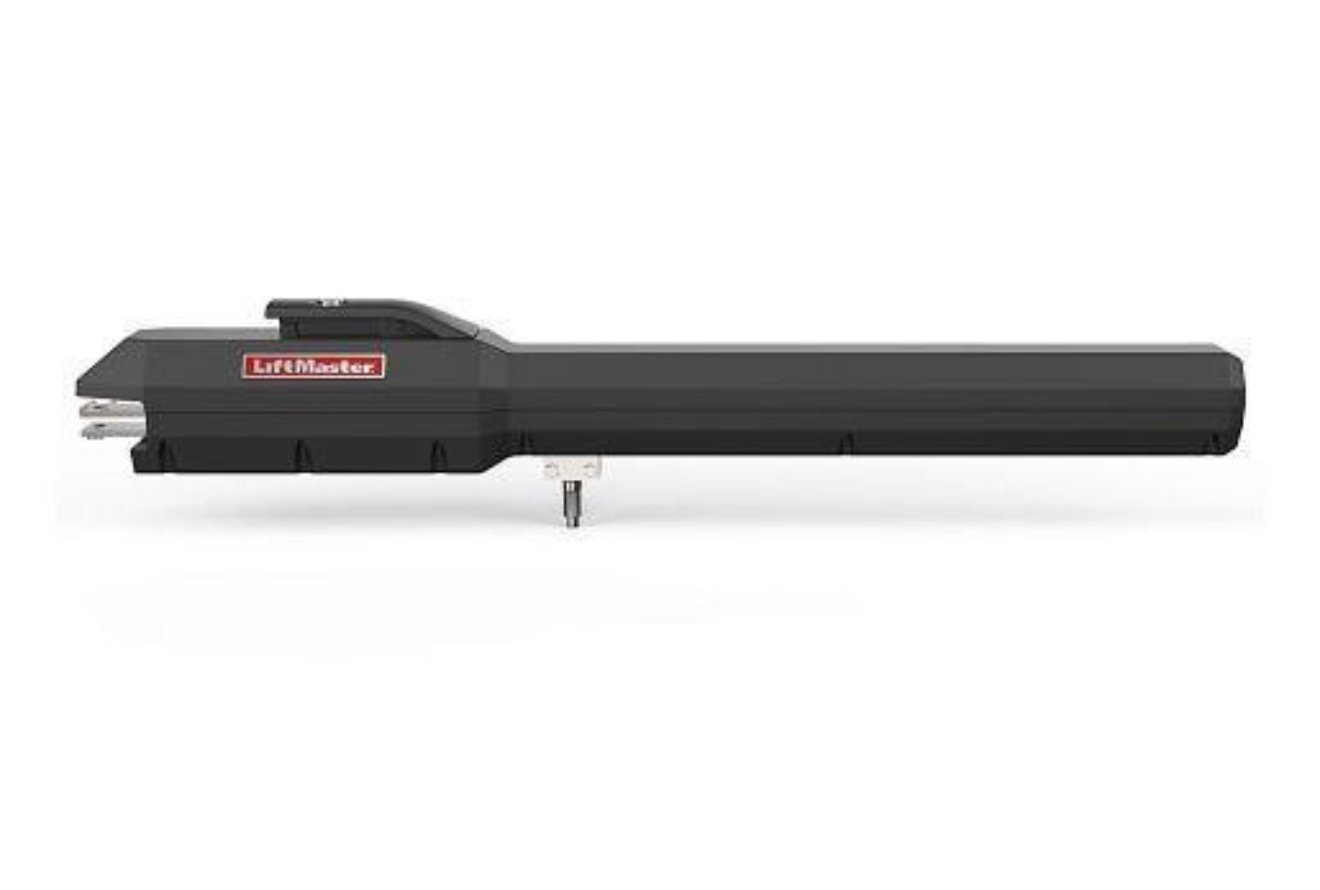
LiftMaster is one of the most common gate operator brands we service across DFW, in both residential swing-arm and commercial slide-gate configurations. Its wide install base means most failures we see fall into recognizable, well-documented patterns — which makes diagnosis faster and repair costs more predictable than with less common brands.
This guide covers the main LiftMaster operator types, what typically fails on each, and realistic repair pricing. If you need a technician now, see our LiftMaster gate repair service.
On this page: LiftMaster operator types · Common LiftMaster failures · Repair cost by issue · Repair vs. replacement · Safety code & compliance · DFW & Allen specifics · Common mistakes · Maintenance tips · Choosing a repair company · Glossary · FAQ
LiftMaster Operator Types We Service
Quick answer: LiftMaster makes both residential swing-arm operators and commercial-duty slide and swing operators, sized for different gate weights and daily cycle counts. Using the wrong duty class for your traffic level is a leading cause of premature failure.
Residential LiftMaster swing operators are built for single-family driveway gates with relatively low daily cycles. Commercial-duty LiftMaster operators — used on slide gates and heavier swing gates — are built for the higher cycle counts seen at HOA entries, apartment complexes and commercial properties.
Common LiftMaster Failures
- Control board failure — the most common issue after storm-related power surges; LiftMaster boards are otherwise reliable but not surge-proof.
- Capacitor failure — a common cause of a motor that hums but doesn’t move the gate.
- Gear/sprocket wear — on higher-cycle commercial units, seen as grinding noise or slower operation.
- Photo-eye or safety loop faults — the same entrapment-protection issues common to any brand.
- Battery backup failure — on models with battery backup, an aged battery can leave the gate unresponsive during a power outage.
LiftMaster Repair Cost by Issue
Quick answer: Sensor and photo-eye repairs typically run $150–$300. Control board replacement typically runs $300–$800. Capacitor replacement typically runs $150–$350. A full LiftMaster operator replacement typically runs $900–$2,800+ depending on the model and gate weight.
| Issue | Estimated Cost Range |
|---|---|
| Photo-eye / safety sensor | $150–$300 |
| Capacitor replacement | $150–$350 |
| Control board replacement | $300–$800 |
| Battery backup replacement | $100–$250 |
| Full operator replacement | $900–$2,800+ |
These ranges help with planning but aren’t a quote — final pricing depends on the specific LiftMaster model and an on-site diagnostic.
Repair vs. Replacement for LiftMaster Operators
Most LiftMaster issues — sensors, capacitors, even control boards — are worth repairing on an operator under about 10 years old, since parts are widely available and well-documented. Replacement makes more sense when the operator has had multiple failures, was undersized for the gate from the start, or is an older discontinued model where parts are getting harder to source.
UL 325 and LiftMaster Safety Devices
Quick answer: LiftMaster operators are UL 325-listed, and the entrapment-protection requirements apply regardless of brand. Bypassing a LiftMaster safety sensor to resolve a nuisance fault is a code violation, not a fix.
LiftMaster operators are certified to meet UL 325 entrapment-protection standards, and that certification depends on the safety sensors and loops remaining functional — not on the brand of operator installed. Repairs on gate access systems in Texas should be done by a company licensed under the Texas DPS Private Security Program; A1’s license number is B31188501.
LiftMaster Repair Across Dallas, Fort Worth and Allen
LiftMaster is one of the most common operator brands we encounter across Allen, Plano, Frisco and McKinney, on both residential driveway gates and HOA community entries. North Texas storm activity makes control board and surge-related repairs a frequent call across this market.
Common Mistakes in LiftMaster Repairs
- Replacing the whole operator when the actual issue was an isolated capacitor or control board.
- Installing a residential-duty LiftMaster unit on a gate seeing commercial-level daily traffic.
- Skipping surge protection on the control board in a storm-prone area, leading to repeat failures.
Maintenance Tips Specific to LiftMaster Operators
Beyond general gate maintenance, LiftMaster operators benefit from periodic capacitor inspection (a common early-failure part) and confirming any battery backup is holding a charge. See our gate maintenance and lifespan guide for a full maintenance schedule.
Choosing a LiftMaster Repair Provider
- Do you hold a Texas license for gate access work? (Yes, Texas License #B31188501.)
- Do you carry common LiftMaster parts, or order-and-wait? Stocking common parts means faster repairs.
- Will you diagnose the actual failed part before recommending a full replacement?
- Do you test safety devices after the repair? Non-negotiable on any gate repair.
Glossary: LiftMaster Repair Terms Worth Knowing
| Capacitor | A component that helps start the operator’s motor; a common early-failure part. |
| Duty Class | The daily-cycle rating an operator is built for (residential vs. commercial). |
| Battery Backup | An internal battery that keeps some LiftMaster models operating during a power outage. |
| UL 325 | The safety standard governing entrapment-protection requirements for gate operators. |
Getting a LiftMaster Operator Repaired
Because LiftMaster repair cost depends on the specific failure and model, we diagnose on-site before quoting. Call 682-516-9940 to schedule a LiftMaster diagnostic, including same-day or 24/7 emergency visits.
Frequently Asked Questions
Can I add phone control to an older LiftMaster gate operator?
Sometimes. Some LiftMaster gate operators work with the myQ app, either built in on newer models or through a compatible LiftMaster accessory, but many older operators don't support it. Compatibility depends on the exact model, so we check the label on the operator before recommending anything.
Is a bad capacitor a common LiftMaster repair?
Yes. On LiftMaster models with an AC motor, a failed start capacitor is a frequent reason the operator hums but won't move the gate, and it's usually a less expensive repair than replacing the operator.
How much does LiftMaster control board replacement cost?
Control board replacement typically runs $300 to $800, depending on the specific model.
Is it worth repairing an older LiftMaster operator?
Usually yes if it's under about 10 years old and the failure is isolated, since LiftMaster parts are widely available. Older discontinued models may be harder to source parts for.
Do LiftMaster operators need special maintenance?
General gate maintenance applies, plus periodic capacitor inspection and checking any battery backup for a healthy charge.
Are LiftMaster operators UL 325 certified?
Yes, LiftMaster operators are UL 325-listed, and the same entrapment-protection safety requirements apply as with any certified operator brand.
Why is my LiftMaster gate operator beeping?
On many LiftMaster operators, the alarm means the gate sensed two obstructions in a row and shut down for safety, as UL 325 requires. Clear whatever is in the way, check the photo-eyes and edges, then press the reset button. If the alarm comes back, the diagnostic codes on the board point to the cause.
Can a LiftMaster operator be undersized for a gate?
Yes. Every LiftMaster model has limits on gate weight, length and daily cycles. If the gate exceeds them, for example a heavy iron gate or a busy community entrance on a residential-duty unit, the motor and gears wear out long before they should.
How long will a LiftMaster battery backup run the gate?
It depends on the model, the battery's age and how often the gate cycles. Many LiftMaster DC operators keep running from the battery for a while after power is lost, while models without a battery stop until power returns and must be released by hand. Batteries weaken with age and heat, so they should be tested at each service.
Is my LiftMaster operator still under the manufacturer's warranty?
Check the install date and LiftMaster's warranty terms for your model. That coverage is between you and LiftMaster, and we can't promise it. Repairs we perform come with our 1-year workmanship warranty.