An automatic gate that won’t open is one of the most disruptive things that can happen to a property — it blocks residents, deliveries, staff, even emergency access. And like access control, gate repair pricing isn’t one number: it depends entirely on which of the gate’s systems actually failed. A blown fuse and a burned-out motor look identical to a homeowner (the gate just doesn’t move) but cost very different amounts to fix.
This guide walks through how automatic gate systems actually work, what typically fails and why, what those repairs cost, and how to tell a legitimate repair recommendation from an upsell. Not sure what your gate's specific symptom means? See our gate troubleshooting guide. Planning a brand-new gate instead? See our gate installation cost guide. By the end you’ll be able to have an informed conversation with any technician who shows up at your gate — including ours.
On this page: How gate systems are built · Repair cost by problem type · Why gates actually fail · Safety code & compliance · DFW & Allen specifics · Residential vs. commercial vs. HOA · Common mistakes · Repair process · Maintenance & lifespan · Choosing an installer · Glossary · FAQ
How an Automatic Gate System Is Actually Built
Quick answer: An automatic gate is four systems working together: the gate operator (motor), the control board and electronics, safety sensors/safety loops, and an entry method like a keypad, card reader or telephone entry. A failure in any one stops the gate, but the fix and cost are completely different for each.
1. The Gate Operator (Motor)
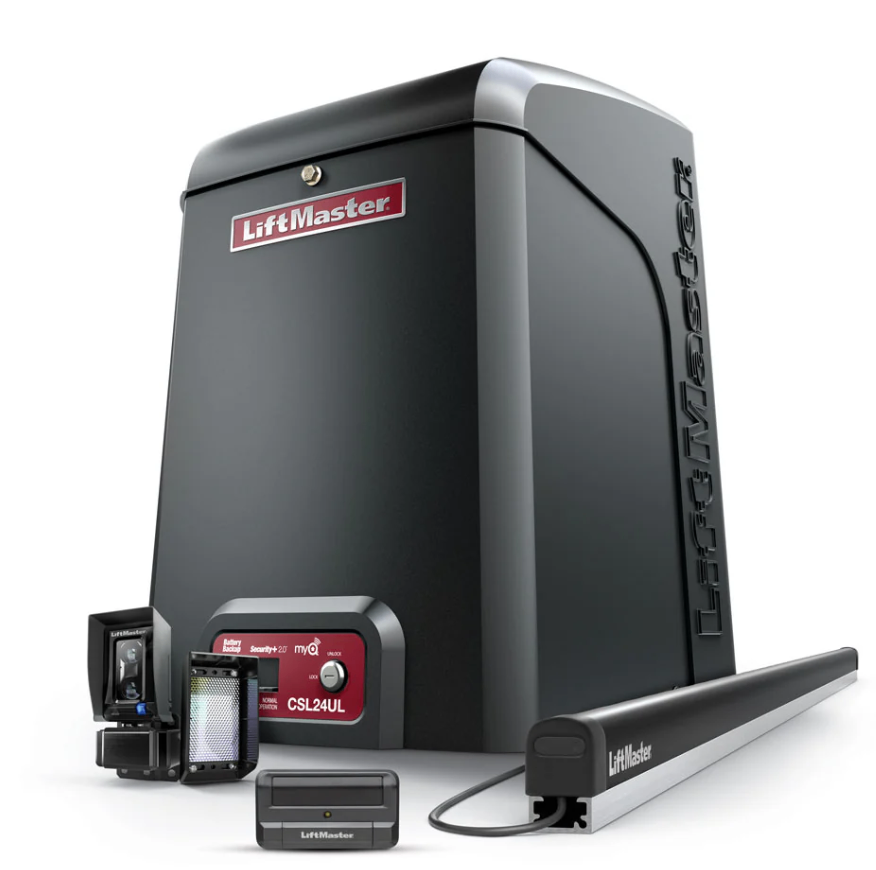
This is the physical motor that swings or slides the gate. Operators are sized to the gate’s weight and usage cycle — an undersized operator installed to save money upfront is one of the most common root causes of repeat failures we see. Common commercial and residential brands in this market include LiftMaster, DoorKing, FAAC, Viking, Linear and Nice.
2. The Control Board and Electronics
The control board is the gate’s brain — it reads inputs (safety sensors, entry requests), runs timers, and drives the motor. The photo above shows a LiftMaster control board inside its enclosure during a repair visit. This is the component most vulnerable to power surges, especially after North Texas storms.
3. Safety Sensors and Safety Loops
Photo-eye sensors and in-ground safety loops detect an obstruction (a car, a person) and stop the gate from closing on it. These are required safety devices, not optional extras — and they’re also the most common single point of failure because loop wiring is buried and exposed to ground movement and moisture.
4. The Entry Method
Keypads, card/fob readers, and telephone entry/intercom systems all trigger the gate to open. These integrate with the same access control principles covered in our access control cost guide — a gate is, in effect, a very large electrified door.
Gate Repair Cost by Problem Type
Quick answer: Sensor and safety-loop repairs are typically the least expensive gate fix, often $150–$400. Control board and electronics repairs after surge damage typically run $300–$800. A full motor/operator replacement is the largest expense, often $800–$2,500+ depending on the gate’s weight, brand and whether wiring also needs work.
| Problem Type | Estimated Cost Range | Typical Cause |
|---|---|---|
| Safety sensor / photo-eye | $150–$300 | Misalignment, weather exposure, wiring wear |
| Safety loop | $200–$400 | Buried wiring damaged by ground movement or moisture |
| Control board / electronics | $300–$800 | Power surge, age, moisture intrusion in enclosure |
| Hinges, rollers, track | $150–$600 | Wear, impact damage, ground settling |
| Motor/operator replacement | $800–$2,500+ | End of service life, chronic undersizing, repeated repairs |
Figures are general starting ranges for planning purposes only, not a quote — the only way to get an accurate number is an on-site diagnostic.
Why Gates Actually Fail
Quick answer: The most common root causes across DFW are power surges (especially after storms), safety-loop wiring worn out from ground movement and moisture, and gate operators that were undersized for the gate’s weight at the original install — which leads to repeated, avoidable repairs.
- Power surges — North Texas storms are a leading cause of fried control boards.
- Undersized operators — a motor rated below the gate’s actual weight wears out years early.
- Buried wiring degradation — safety loop and sensor wiring exposed to ground moisture over years.
- Lack of routine maintenance — hinges and rollers that are never lubricated or adjusted put extra strain on the motor.
- Physical impact — vehicle contact bending the gate frame or track out of alignment.
Safety Code and Compliance
Quick answer: Automatic gate operators sold and installed in the U.S. must meet UL 325 safety requirements, and gate/fence assemblies are commonly built to ASTM F2200 standards. Entry points serving the public also need to account for ADA accessibility. In Texas, gate and access installers are licensed through the TDLR.
UL 325 requires entrapment-protection safety devices — the photo-eyes and safety loops discussed above — on both vehicular and pedestrian automatic gates. This isn’t optional hardware; it’s a safety requirement that exists because an unprotected gate can genuinely injure someone. If a technician suggests removing or bypassing a safety sensor to "fix" a nuisance fault, that's a red flag, not a solution — the correct fix is diagnosing why the sensor is faulting. Gate and fence construction commonly follows ASTM F2200 guidance, and public-serving entries should account for ADA accessibility. As with access control, gate installers in Texas are licensed through the TDLR — ours is License #B31188501.
Gate Repair Across Dallas, Fort Worth and Allen
Gated single-family neighborhoods and HOA communities are common throughout Allen, Plano, Frisco and McKinney, and most of our gate calls in those areas involve either a vehicle entry gate serving dozens of homes or a single-family swing gate. Commercial and industrial properties along DFW’s logistics corridors more often run heavier slide gates and industrial operators that see far more open/close cycles per day, which changes the maintenance schedule and the parts that wear out first. We’re based out of Allen, so North Texas gate calls don’t mean a long wait for a technician.
Residential vs. Commercial vs. HOA Gate Systems
Residential gates are usually a single swing or slide gate on a driveway, paired with a keypad or mobile app, and see relatively low daily cycle counts.
HOA and gated community gates see far more traffic and typically pair a vehicle gate operator with a telephone entry system so residents can let guests in remotely — see our intercom systems page for how that pairs with gate access. Many of these properties also pair the gate with security cameras covering the entry lane.
Commercial and industrial gates are often larger slide gates protecting a yard, warehouse or fleet lot, built for higher-cycle commercial-duty operators and sometimes integrated with the same access control credentials used on the building’s doors.
Repair vs. Replacement: How to Decide
${QA('Repair the operator if it\u2019s under about 8\u201310 years old, correctly sized for the gate, and the failure is isolated (a sensor, a fuse, a control board). Replace it if it\u2019s repeatedly failed, was undersized from the original install, or parts are no longer supported by the manufacturer.')}The honest answer depends on three things: the operator’s age, how many times it’s already been repaired, and whether it was correctly sized for the gate in the first place. An operator that’s failed once in eight years for an isolated reason is usually worth repairing. An operator that’s had three service calls in two years, or was clearly undersized from day one, is telling you that repair is just delaying an inevitable replacement — and probably costing more in cumulative service calls than a single replacement would.
Parts availability matters too. Some older or discontinued operator models become harder to source control boards for over time, which can turn a simple electronics repair into a full operator swap by necessity rather than choice.
Can You Diagnose or Fix a Gate Problem Yourself?
Some basic checks are safe for a property owner to do before calling a technician: confirm the operator has power, check that nothing is physically blocking the photo-eye sensors, and look for obvious debris in the gate track. Beyond that, we’d caution against DIY repair — gate operators involve both line-voltage electrical work and safety-critical entrapment-protection devices, and an incorrectly wired or misadjusted safety sensor can create a genuine hazard rather than just an inconvenience.
Common Mistakes We See During Gate Repairs
These come up repeatedly when we’re called to fix or take over a gate that someone else worked on:
- Bypassing or disconnecting a faulting safety sensor instead of diagnosing the actual fault — this is a safety-code violation, not a fix.
- Replacing a motor without addressing the safety loop or wiring issue that was straining it in the first place, leading to a repeat failure.
- Installing a residential-duty operator on a gate with commercial-level daily cycles, which shortens its life dramatically.
- Ignoring hinge, roller and track wear until it damages the motor that has to fight the added friction.
- Skipping surge protection on the control board in an area that sees regular storm activity, leading to repeat electronics failures.
What to Expect During a Gate Repair Visit
- Diagnostic visit — we test the operator, control board, safety devices and entry method to isolate the actual cause, not just the symptom.
- Written estimate — an itemized quote covering parts and labor before any repair work begins.
- Repair or replacement — addressing the root cause, not just resetting the system.
- Safety device testing — confirming photo-eyes and safety loops function correctly before we leave.
- Walkthrough — showing you what failed, why, and what (if anything) to watch for going forward.
Maintenance and Lifespan
Routine maintenance is the single biggest lever property owners have over automatic gate repair costs. Lubricating hinges and rollers, checking safety sensor alignment, and testing safety loops a couple of times a year catches small issues before they strain the motor. A well-maintained, correctly-sized commercial-duty operator can run for well over a decade; the parts that typically wear first are mechanical — hinges, rollers, chains — from daily cycling, not the electronics. For a complete maintenance schedule and cost breakdown, see our Gate Maintenance and Lifespan guide.
Questions to Ask Before Hiring a Gate Repair Company
Because gate repair touches both physical safety and property access, the technician matters as much as the parts. Here’s what to ask, and why:
- Are you licensed and insured in Texas? (We are — TDLR License #B31188501.) An unlicensed technician leaves you with no recourse if the repair fails or damages your property.
- Will you diagnose the root cause before recommending a repair? A motor replacement that ignores a failing safety loop is a repeat repair waiting to happen.
- Do you test safety devices before you leave? A gate that closes without working entrapment protection is a genuine safety hazard, not a minor detail.
- Do you offer emergency/same-day service? A stuck gate can trap vehicles or block emergency access, so response time matters.
- Will you give me a written, itemized estimate before starting work? You should see parts and labor broken out separately, not a single verbal number.
- What brands do you service? Confirm they actually support your operator’s brand (LiftMaster, DoorKing, FAAC, Viking, Linear, Nice, etc.) rather than forcing a full replacement because they don’t. See our dedicated LiftMaster repair guide for brand-specific pricing.
Glossary: Gate Repair Terms Worth Knowing
| Operator | The motor assembly that physically moves the gate. |
| Control Board | The electronics that process inputs and drive the operator. |
| Safety Loop | Wire embedded in the driveway that detects a vehicle and prevents the gate closing on it. |
| Photo-Eye Sensor | An infrared beam pair that stops the gate if something breaks the beam. |
| UL 325 | The safety standard governing entrapment-protection requirements for automatic gate operators. |
| Telephone Entry | A call-box/intercom system letting visitors call a resident to request gate access. |
Getting an Accurate Gate Repair Estimate
Because gate repair cost depends entirely on which component failed and the gate’s age, brand and daily use, we diagnose on-site before quoting. Call 682-516-9940 for same-day and 24/7 emergency service, or request a free estimate below. Ask about Sunbit financing for larger motor or operator replacements.
Frequently Asked Questions
Why won’t my automatic gate open?
The most common causes are a tripped or misaligned safety sensor, a surge-damaged control board, or a worn-out operator/motor. A technician can usually isolate the exact cause during an on-site diagnostic.
Is it cheaper to repair or replace a gate motor?
Repair is usually cheaper for an isolated issue, but if the operator is old, undersized for the gate, or has needed repeated repairs, replacement is often the better long-term value. We’ll tell you honestly which applies to your gate.
Do you offer emergency gate repair in Dallas–Fort Worth?
Yes, we offer same-day and 24/7 emergency gate repair service across the DFW area, including Allen, Plano, Frisco and McKinney.
What is a safety loop and why did mine stop working?
A safety loop is wiring embedded in the driveway that detects a vehicle so the gate won’t close on it. Safety loops most often fail from ground movement, moisture intrusion, or age-related wire degradation.
Is it safe to bypass a faulty gate sensor to keep using the gate?
No. Safety sensors and loops are required entrapment-protection devices under UL 325, not optional extras. A faulting sensor should be diagnosed and repaired, not disconnected.
How much does a gate motor replacement cost?
A full operator replacement typically runs from about $800 to $2,500 or more, depending on the gate’s weight, the operator brand, and whether wiring also needs to be replaced.
What gate operator brands do you service?
We install and repair operators from brands including LiftMaster, DoorKing, FAAC, Viking, Linear and Nice.
Can a gate be integrated with access control or a telephone entry system?
Yes, most gate operators can be paired with a keypad, card reader, mobile credential or telephone entry/intercom system so residents, staff or guests can trigger the gate remotely.
How often should an automatic gate be serviced?
We recommend at least twice-yearly maintenance visits to lubricate hardware, check safety sensor alignment, and test the safety loop, which catches small issues before they strain the motor.
Is financing available for gate repair or replacement?
Yes, we offer Sunbit financing so larger repairs or full operator replacements can be spread over monthly payments.
What causes gate control boards to fail after a storm?
Power surges from lightning strikes or grid fluctuations are a leading cause of control board failure in North Texas. Surge protection at the control board reduces this risk.
Do commercial gates need a different operator than residential gates?
Yes. Commercial and industrial gates see far more open/close cycles per day and need a commercial-duty operator rated for that use — a residential-duty motor installed on a high-cycle commercial gate will wear out early.