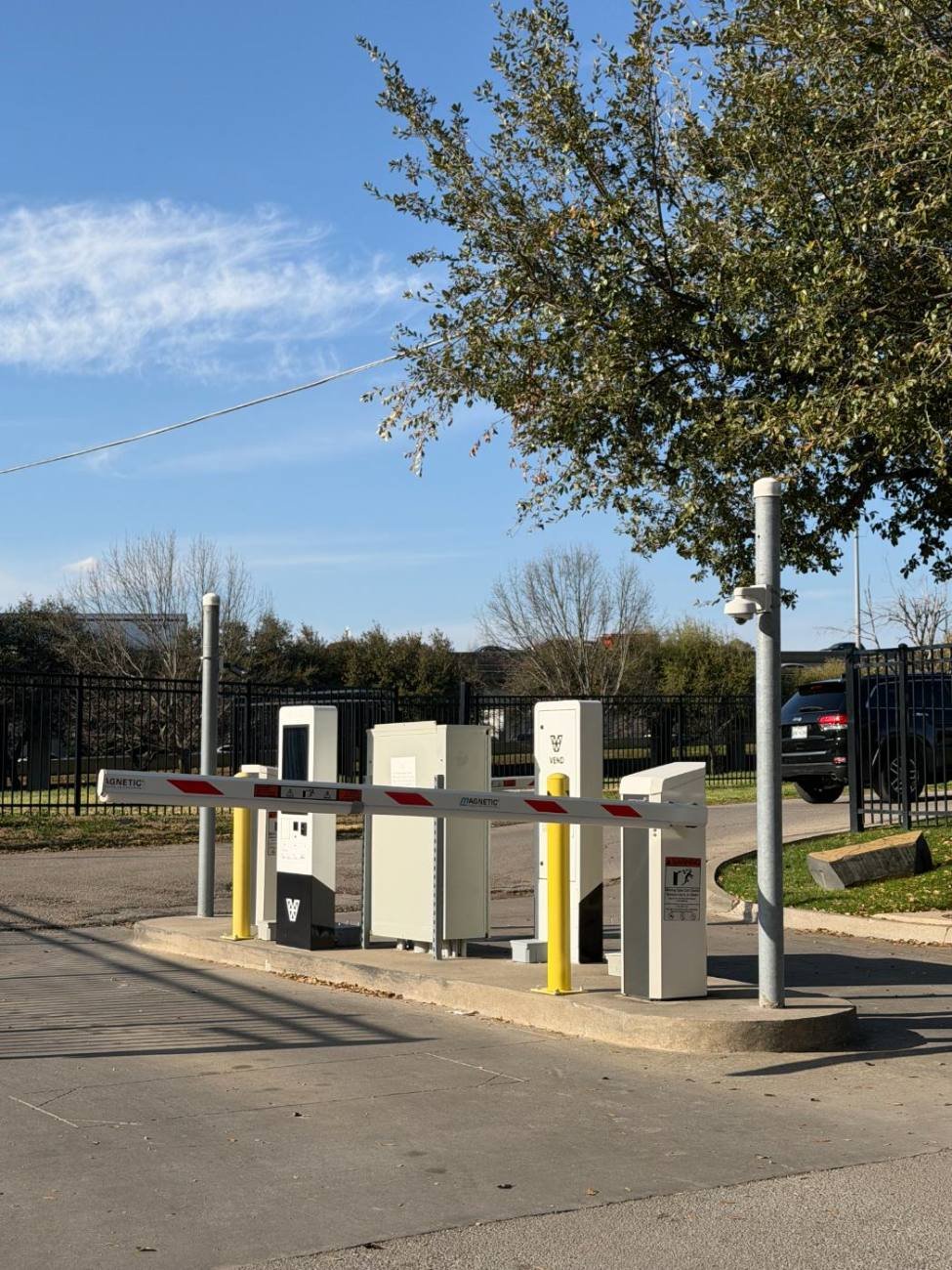
A new automatic gate is one of the highest-impact upgrades a property can make — it controls who and what gets onto the property before they ever reach the front door. But unlike a repair, a new installation is a project with real design decisions: gate type, operator sizing, entry method, wiring runs, and code compliance all have to be planned together, and each one moves the price.
This guide breaks down what a proper automatic gate installation actually involves, what it costs by gate type in the Dallas–Fort Worth market, and what separates a gate that runs reliably for fifteen years from one that’s back on a service call within twelve months.
On this page: What goes into an installation · Cost by gate type · Swing vs. slide cost · What drives price · Safety code & compliance · DFW & Allen specifics · Residential vs. commercial vs. HOA · Common mistakes · Installation process · Maintenance & lifespan · Questions to ask · Glossary · FAQ
What Goes Into a New Gate Installation
Quick answer: A complete installation covers the gate itself (material and fabrication), the operator (motor), underground electrical and control wiring, safety devices, an entry method, and site work like footings or track. Skipping any one of these to save money up front is where most future repair calls come from.
1. The Gate
Ornamental iron, aluminum, wood and steel are the most common materials in this market. The gate’s weight and wind load directly determine what size operator it needs — this is decided at design time, not after the fact.
2. The Operator (Motor)
Swing gates use arm or underground operators; slide gates use a track-mounted operator with a drive gear. Brands we install and service include LiftMaster, DoorKing, FAAC, Viking, Linear and Nice, sized to the gate’s weight and expected daily cycle count.
3. Underground Electrical and Control Wiring
Every automatic gate needs conduit run from a power source to the operator, plus low-voltage wiring for safety loops, sensors and the entry device. This is trenching and electrical work, and it’s one of the most site-specific cost variables — a gate 200 feet from the nearest power source costs more to wire than one 20 feet away.
4. Footings and Site Work
Swing gates need concrete footings for the hinge and latch posts sized to the gate’s weight and local soil conditions; slide gates need a level track bed and a receiver post. Skimping on footing depth is a leading cause of gates going out of alignment within a few years.
5. Safety Devices and Entry Method
Photo-eye sensors and safety loops are required entrapment-protection devices (more on this below), and an entry method — keypad, card reader, mobile credential, or telephone entry/intercom — triggers the gate. See our access control and intercom systems pages for how these integrate with a new gate.
Automatic Gate Installation Cost by Gate Type
Quick answer: A single residential swing gate installation typically runs $3,500–$7,500 all-in. A residential slide gate runs $4,000–$9,000. Ornamental double-swing driveway gates with stone columns run higher, often $8,000–$18,000+. Commercial and industrial slide gates with heavy-duty operators typically run $10,000–$30,000+ depending on span and site work.
| Gate Type | Estimated Cost Range | Typical Use |
|---|---|---|
| Residential swing gate | $3,500–$7,500 | Single-family driveway, one or two panels |
| Residential slide gate | $4,000–$9,000 | Narrow driveways, sloped sites |
| Ornamental iron w/ stone columns | $8,000–$18,000+ | Upscale residential entries |
| HOA/community vehicle gate | $9,000–$20,000+ | Gated neighborhoods, higher daily cycles |
| Commercial/industrial slide gate | $10,000–$30,000+ | Warehouse yards, fleet lots, longer spans |
Figures are general starting ranges for planning purposes only, not a quote — final pricing depends on an on-site survey of your specific gate, site conditions and power access.
Swing Gate vs. Slide Gate: Cost and Fit Comparison
Quick answer: Swing gates are generally cheaper to install on a flat, level driveway with room for the gate to arc open. Slide gates cost somewhat more up front but are the better (sometimes only) option on sloped driveways, narrow entries, or where a swing arc isn’t possible.
| Factor | Swing Gate | Slide Gate |
|---|---|---|
| Typical install cost | Generally lower | Generally higher (track, receiver post) |
| Site requirements | Flat area for the swing arc | Fence line clearance equal to gate width |
| Sloped driveways | Often difficult or not possible | Usually the better option |
| Best for | Residential driveways with space | Narrow sites, commercial/industrial |
For a deeper breakdown of this decision, see our dedicated Swing Gate vs. Sliding Gate guide — already live and covering site requirements in more depth.
What Drives the Price Up or Down
- Gate material and size — ornamental iron and larger spans cost more than standard aluminum or steel.
- Distance to power — longer conduit runs mean more trenching and electrical labor.
- Site conditions — slope, soil type and existing hardscape affect footing and track work.
- Operator duty cycle — commercial-duty operators for high daily use cost more than residential-duty units.
- Entry method — a simple keypad costs less than a telephone entry/intercom system or multi-credential access control.
- Solar vs. line power — a solar-powered operator avoids a long conduit run but adds panel and battery cost.
Safety Code and Compliance
Quick answer: New automatic gate installations must meet UL 325 entrapment-protection requirements, and gate/fence assemblies commonly follow ASTM F2200 construction standards. Public-serving entries should account for ADA accessibility, and gate installers in Texas are licensed through the TDLR.
UL 325 requires safety devices — photo-eyes and safety loops — on new vehicular and pedestrian gate installations; this isn’t optional, it’s what prevents a gate from closing on a vehicle or person. New gate and fence assemblies commonly follow ASTM F2200 construction guidance, and entries serving the public should account for ADA accessibility requirements. In Texas, gate and access installers are licensed through the TDLR — ours is License #B31188501. Some municipalities and HOAs also require a permit or design review before a new gate is installed; we handle that coordination as part of the project.
Gate Installation Across Dallas, Fort Worth and Allen
New gate installations across Allen, Plano, Frisco and McKinney are most often single-family driveway gates or HOA community entries, while properties along DFW’s logistics corridors more often need heavier commercial slide gates built for high daily cycle counts. We’re based out of Allen, so North Texas installs don’t mean a long wait between the site survey and install day.
Residential vs. Commercial vs. HOA Gate Installations
Residential installations are usually a single swing or slide gate paired with a keypad or mobile app, sized for low daily cycle counts.
HOA and gated community installations see far more traffic and typically pair a vehicle gate operator with a telephone entry system so residents can admit guests remotely — see our intercom systems page for how that pairs with gate access. Many of these properties also add security cameras covering the entry lane.
Commercial and industrial installations are often larger slide gates protecting a yard, warehouse or fleet lot, built with commercial-duty operators and sometimes integrated with the same access control credentials used on the building’s doors.
Common Mistakes We See in Gate Installations
- Undersizing the operator to save money up front, leading to early motor failure and repeat repairs.
- Skipping or under-sizing footings, which leads to gate posts shifting and gates going out of alignment within a few years.
- Installing safety sensors as an afterthought instead of designing them into the wiring plan from the start.
- Choosing a slide gate for a site without enough fence-line clearance, or a swing gate on a site that’s too sloped for it.
- Skipping surge protection on the control board in an area that sees regular storm activity.
What to Expect During a Gate Installation Project
- Site survey — measuring the driveway, checking slope and power access, and confirming gate type and operator sizing.
- Written estimate — an itemized quote covering the gate, operator, wiring, footings and entry method.
- Permitting — coordinating any required municipal or HOA approval before work begins.
- Site work and footings — trenching for conduit and pouring footings or preparing the track bed.
- Gate and operator installation — hanging the gate, mounting the operator, and wiring safety devices and the entry method.
- Programming and testing — configuring the control board and entry method, and testing safety devices before we leave.
- Walkthrough — showing you how to use and maintain the system going forward.
Maintenance and Lifespan
A properly installed and correctly sized gate operator can run reliably for well over a decade. Routine maintenance — lubricating hinges and rollers, checking safety sensor alignment, and testing safety loops a couple of times a year — is the biggest factor in reaching that lifespan. For a full breakdown, see our Automatic Gate Maintenance and Lifespan guide, already live.
Questions to Ask Before Hiring a Gate Installer
- Are you licensed and insured in Texas? (We are — TDLR License #B31188501.)
- Will you do a site survey before quoting? Accurate pricing depends on measuring your specific driveway and power access.
- How is the operator sized for my gate? Ask them to explain the gate’s weight and expected daily cycles, not just quote a generic unit.
- What footing depth do you use, and why? This should be based on your gate’s weight and local soil, not a one-size-fits-all number.
- Do you handle permitting and HOA approval? Some municipalities and communities require sign-off before installation.
- Will you give me a written, itemized estimate? You should see the gate, operator, wiring and site work broken out separately.
Glossary: Gate Installation Terms Worth Knowing
| Operator | The motor assembly that physically moves the gate. |
| Safety Loop | Wire embedded in the driveway that detects a vehicle and prevents the gate closing on it. |
| Photo-Eye Sensor | An infrared beam pair that stops the gate if something breaks the beam. |
| UL 325 | The safety standard governing entrapment-protection requirements for automatic gate operators. |
| ASTM F2200 | The construction standard commonly followed for automated gate and fence assemblies. |
| Telephone Entry | A call-box/intercom system letting visitors call a resident or tenant to request gate access. |
Getting an Accurate Gate Installation Estimate
Because gate installation cost depends on gate type, site conditions and distance to power, we do a site survey before quoting. Call 682-516-9940 to schedule one, or request a free estimate below. Ask about Sunbit financing for larger installations.
Frequently Asked Questions
How much does it cost to install an automatic gate in Dallas?
Most residential swing or slide gate installations run $3,500–$9,000, while ornamental or HOA community gates often run $8,000–$20,000+, and commercial slide gates run $10,000–$30,000+ depending on span and site work.
Is a swing gate or slide gate cheaper to install?
Swing gates are generally less expensive to install on a flat, level driveway. Slide gates cost somewhat more but are often the better or only option on sloped or narrow sites.
What is the most expensive part of a gate installation?
Site work — trenching for power, footings, and any needed electrical upgrades — is often the largest variable cost, more so than the gate or operator itself.
Do automatic gates need a permit in Dallas–Fort Worth?
Some municipalities and HOAs require a permit or design review before installation. We handle that coordination as part of the project.
What safety features are required on a new automatic gate?
New installations must include entrapment-protection devices — photo-eye sensors and/or safety loops — per UL 325, on both vehicular and pedestrian gates.
Can a new gate be solar powered?
Yes. A solar-powered operator is a good option where running line power to the gate would require a long, costly conduit run.
How long does a gate installation take?
Most residential installations take one to three days depending on site work; commercial and HOA projects with more site work or longer spans can take longer.
What brands of gate operators do you install?
We install and service operators from brands including LiftMaster, DoorKing, FAAC, Viking, Linear and Nice.
Can a new gate be integrated with access control or an intercom?
Yes. Most gate operators can be paired with a keypad, card reader, mobile credential, or telephone entry/intercom system.
How long does a new automatic gate last?
A properly installed, correctly sized operator with routine maintenance can run reliably for well over a decade.
Do you offer financing for gate installation?
Yes, we offer Sunbit financing for larger gate installation projects.
Do you serve Allen and the greater DFW area for gate installation?
Yes, we install automatic gates across Dallas, Fort Worth, Allen, Plano, Frisco, McKinney and the surrounding North Texas area.