Card Reader or Keypad Not Working?
A card reader that won’t read, a fob that works one day and not the next, or a keypad that suddenly rejects every code can lock staff, tenants and deliveries out of a building. A1 Security Gate & Intercom provides card reader repair and keypad repair for businesses, offices, warehouses, clinics and apartment communities across Dallas–Fort Worth, including readers on doors, pedestrian gates and vehicle gates. We repair readers of all brands, including ones another company installed, with 24/7 emergency service when a main entrance is down.
Card Reader Blinking Red? What the Lights and Beeps Usually Mean
The reader’s LED and beeper are controlled partly by the reader and partly by the panel it’s wired to, so the same color can mean different things on different systems. That’s why searches like “HID reader blinking red” turn up conflicting answers. In general terms, on many systems:
- Steady red: the reader has power and is idle. The door is locked and waiting for a credential.
- Short green flash, often with a beep: access was granted. If the door still doesn’t open, the problem is the lock or its power, not the reader.
- Red flash with several beeps: the card was read but denied. The card may not be enrolled, may be expired, or may be outside its schedule.
- Blinking red, or alternating red and green, with no one at the reader: often a sign the reader has lost communication with the panel, is in a tamper alarm, or is stuck in a setup mode.
- No lights at all: no power, from a blown fuse, failed supply, cut cable or dead reader.
If you can tell us what the light does and whether it beeps when a card is presented, we can usually narrow the problem down before the visit.
Common Card Reader Problems We Repair
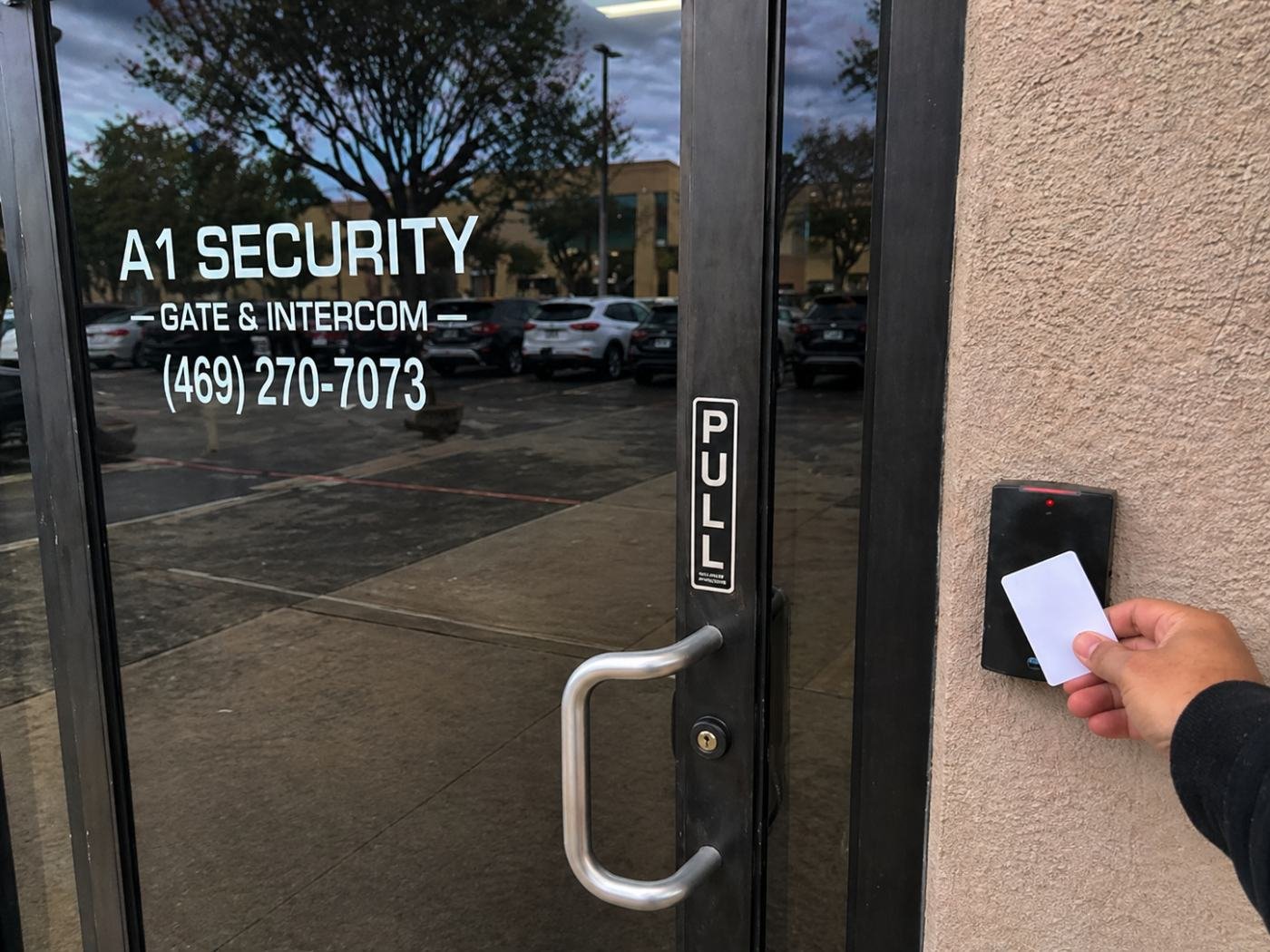
Card Reader Not Reading Cards or Fobs
No beep and no light change when a card is presented usually points to one of four things: the card and reader use different technologies (for example, a 125 kHz prox card on a reader set up only for smart cards), the card or fob is damaged, the reader has failed, or the reader isn’t powered. Safe to check first: try a second card that works on another door. If one card fails and others work, it’s the card. If every card fails, it’s the reader, the wiring or the panel.
Key Fob Reader Not Working Sometimes
Readers that work only some of the time are often the hardest to pin down. Common causes are loose connections, voltage drop on a long cable run, a shared power supply that dips every time the lock fires, a reader mounted flat on metal that cuts its read range, or moisture getting into the back box. If it gets worse after rain or on hot afternoons, that’s a useful clue to tell the technician.
Door Keypad Not Accepting Codes
Keypads wear out in a predictable way: the most-used buttons go smooth or stick, and worn keys can also give away part of the code. Other causes include moisture behind the keypad, codes that were deleted or expired in the software, and keypads that lock out for a period after too many wrong entries. We repair or replace worn keypads and can switch you to a combination keypad and card reader if you want to move away from shared codes.

Wiegand and OSDP Wiring Problems
Most readers talk to the panel one of two ways. Wiegand is the older one-way connection that uses separate wires for data, power, LED and beeper. OSDP is a newer two-way connection over a shielded pair that lets the panel supervise the reader and encrypt the data. Wiegand problems we find include swapped data wires (cards read but come through as the wrong number, so they’re denied), a missing common ground, cable runs that are too long or too thin, and unshielded cable run beside high-voltage wiring. OSDP problems include wrong reader addresses or speeds, missing termination, and a secure-channel mismatch after a reader is swapped, which shows up as the reader going offline. We test at the reader and at the panel, not just by swapping parts.
Outdoor Readers and Weather Damage
Readers on gate pedestals, parking garages and exterior doors take North Texas sun, driving rain and hail. We see cracked housings, faded lenses, water in the conduit and corroded terminals. Repairs include sealing the wiring entry, adding a drip loop, fitting a weather hood and replacing indoor-rated readers with outdoor-rated ones. If the reader is fine but a vehicle gate still won’t open, the operator may be at fault; see our gate repair service.
Replacing Old or Obsolete Readers
Some readers are simply past their life or no longer made. Older 125 kHz proximity cards are also easy to copy. When a reader needs replacing, we match it to your panel and credentials. A multi-technology reader can read your existing cards and newer, more secure ones, so you can switch cards over time instead of all at once. For new doors or a full upgrade, see card reader installation; estimates for new installations are free.
Reader and Keypad Brands We Repair
We service readers and keypads from HID, Keyscan, UniFi Access, Brivo, Paxton, Bosch, GRI, Camden, Seco-Larm and Alarm Controls, plus the panels and Altronix power supplies behind them. We repair systems installed by other companies, all brands, so you don’t need the original installer.
When the Reader Isn’t the Problem
A reader that flashes green but doesn’t open the door is doing its job. The fault is in the lock, the lock’s power or the panel output. Our electric strike repair page covers the most common door-side failures, and our access control repair page covers panels, software and power.
How a Card Reader Repair Visit Works
Describe the Symptom
Tell us which readers are affected, what the light and beeper do, and whether one card or every card fails.
Test at the Door
Service calls start at $180 per hour. We check reader power, read range, wiring and the data reaching the panel.
Repair or Replace
We fix wiring, power and mounting issues on the spot, and replace failed readers or keypads with compatible models.
Verify Credentials
We test cards, fobs and codes, confirm the LED and beeper behave correctly and walk you through what changed.
24/7 Emergency Card Reader Repair
If the only reader on your main entrance is down, or a reader failure has left a door unlocked, call (682) 516-9940. We offer 24/7 emergency service, and same-day service during regular hours when the schedule allows. Learn more about our emergency service, or request a repair visit for anything less urgent.
We repair card readers and keypads in Dallas, Plano, Frisco, Allen, McKinney, Richardson, Irving, Garland, Carrollton, Fort Worth and the surrounding DFW area.